This semester was a heavy technology semester with the ParaMod seminar and the grad studio also using DP. This meant lots of posts and figuring out all sorts of DP related issues. After the intensity and a solid week of final reviews, I am taking a week to focus on some other work. I have ideas for a few more tutorials, one of which will include a DP rule to change the display color of objects and probably a simple ecotech shadow generation.
As far as work goes, PLY is getting busy and John Marshall, Cezanne Charles and I are collaborating again. This time on a Tea House for Robots to be installed in Japan in July. It will be at the Natinoal Museum of Modern Art in Kyoto from July 9 – August 22. Here is a link. We are ramping up this week so once there are images and mock ups I can post some of that work.
Stay tuned, the summer is getting busy already.
Tuesday, May 4, 2010


Monday, April 12, 2010
Karl to give Architecture Keynote at the HATCH Festival
I will be giving the architecture keynote at the Hatch Festival in Ashville, N.C. on April 16, 2010
The festival takes place from April 15-18, 2010.
The mission of HATCH is to provide mentorship, education, inspiration and recognition to the next generation of creative innovators. The focus is on the creative industries and how to best leverage the creative talent to impact the community and the planet in a positive and sustainable way. HATCHfest brings together luminaries in the arts to serve as mentors to groundbreaking new creative talent in the fields of architecture, design/technology, fashion, film, journalism, music, and photography.
Click here for more information on HATCH.

The festival takes place from April 15-18, 2010.
The mission of HATCH is to provide mentorship, education, inspiration and recognition to the next generation of creative innovators. The focus is on the creative industries and how to best leverage the creative talent to impact the community and the planet in a positive and sustainable way. HATCHfest brings together luminaries in the arts to serve as mentors to groundbreaking new creative talent in the fields of architecture, design/technology, fashion, film, journalism, music, and photography.
Click here for more information on HATCH.

Sunday, March 21, 2010
Creation of Data Sheets
Short tutorial shows how to create and manage data sheets. Click the image to start the video.

Saturday, March 20, 2010
Graphic method to create varied intervals
Simple sketch to control the varied lengths for sub-dividing an object. Click the image to view the video.
Click here to download the catpart file.

Click here to download the catpart file.
Saturday, March 6, 2010
Area to Height and Manipulation of Void
Short tutorial that covers conversion of area to height. It also shows the manipulation of a multi-section void.
Click the image to start the video.

Click the image to start the video.
Attractor Point tutorial added
Finally had a chance to go back and complete the video tutorial for the attractor point tutorial.
Click here for the video.
Click here for the video.
Saturday, February 27, 2010
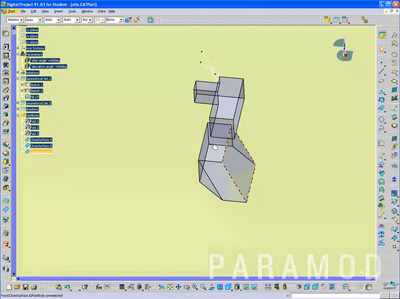
Projecting Solid Shadows
Short tutorial that demonstrates the creation of solid shadows. Click the image to launch the video.
Thursday, February 11, 2010
First time teaching Knowledge Patterns
Last night was the first time to roll out knowledge patterns in the seminar. In the three hour format it was a bit rushed but we have two weeks to work on this assignment so I am optimistic that people wil be able to work through the flow of the various steps and operations.
I am curious to see if the power of the scripting out weights the perceived difficulty of the scripting and the process. I hope that after the two previous weeks everyone is tired of manually instantiating their parts. I am also curious to see what new types of projects will emerge from this type of tool.
I am curious to see if the power of the scripting out weights the perceived difficulty of the scripting and the process. I hope that after the two previous weeks everyone is tired of manually instantiating their parts. I am also curious to see what new types of projects will emerge from this type of tool.
Sunday, February 7, 2010
Document Template Tutorial with Rules
This tutorial starts with an existing framework (download here). I also included two rules to control the circles to always sit inside of the control points.
The document template allows you to deal with advanced replication of solids. It also allows you to create separate files for each part, so that each instance can be modified independently.
If you want to jump ahead to the actual making of the document template you can download the geometry for the part (here).
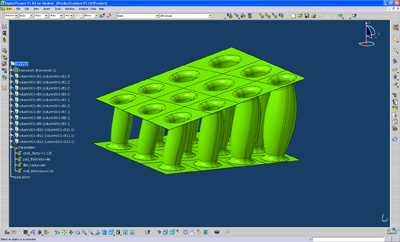
The document template allows you to deal with advanced replication of solids. It also allows you to create separate files for each part, so that each instance can be modified independently.
If you want to jump ahead to the actual making of the document template you can download the geometry for the part (here).
Sunday, January 31, 2010
Attractor Point with Range
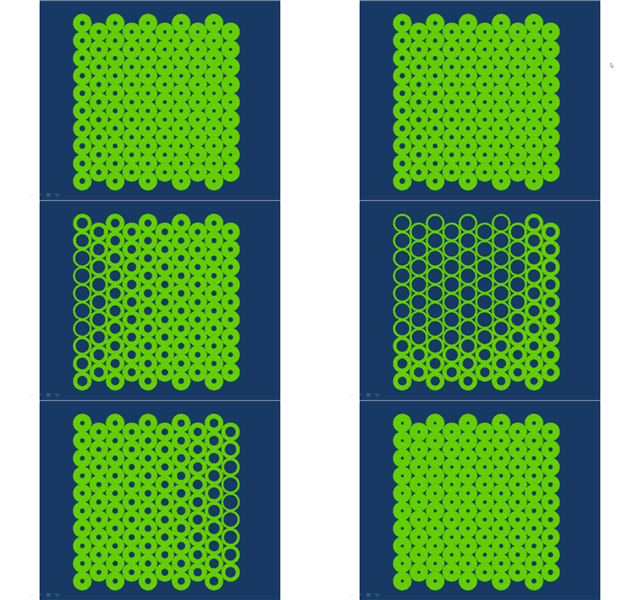
I received a request recently about using an attractor point in DP. This was a famous early Grasshopper example so I figured I could do a simple version using DP. The tutorial also includes a powercopied rule to set the range of the attractor point allowing for greater or lesser impact of the point on the circle radii.
Here is the text for a rule that gets powercopied with the geometry:
Here is the file if anyone wants to work through the example (file here). Click on the image below to start the video.
Here is the text for a rule that gets powercopied with the geometry:
if buildgeo\radius_inner > radius_max
{buildgeo\radius_float = radius_max }
else if buildgeo\radius_inner < radius_min
else if buildgeo\radius_inner < radius_min
{buildgeo\radius_float = radius_min }
else {buildgeo\radius_float = buildgeo\radius_inner }Here is the file if anyone wants to work through the example (file here). Click on the image below to start the video.
Saturday, January 30, 2010

Thursday, January 28, 2010
FAB Lab at Michigan officially opens
Short article in the local paper about the FAB Lab open house. (I hope the robot doesn't crash into the foam mold, obviously placed for the photo!)
The FAB Lab opening was also the topic of a recent local radio interview on the Lucy Ann Lance Business Insider – 1290 WLBY, Ann Arbor, MI. Click here to listen to the January 20th interview.
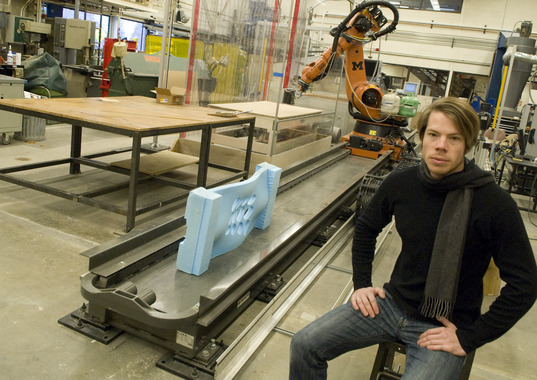
The FAB Lab opening was also the topic of a recent local radio interview on the Lucy Ann Lance Business Insider – 1290 WLBY, Ann Arbor, MI. Click here to listen to the January 20th interview.
Saturday, January 23, 2010
Rules & Powercopies
Here is a DP tutorial that includes powercopies and rules. Instead of creating a range of powercopies with a uniform variation, I model it as lumber with specific sizes. The rule then allows for specific shapes to be placed depending on the context of the framework. The rule is also dynamic so as the context changes the rule is able to update the geometry.
Here is the simple text required to make the rule. Both "depth" and "joist_length" are linked parameters.
if joist_length <= 110in
{depth=5.5in}
else if
joist_length >110in and joist_length<145in
{depth=7.25in}
else if
joist_length >145in and joist_length<185in
{depth=9.25in}
else if
joist_length >185in and joist_length<225in
{depth=11.25in}
else if
joist_length >=225in
{depth=.75in}
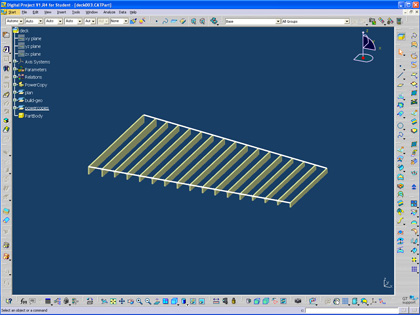
Here is the simple text required to make the rule. Both "depth" and "joist_length" are linked parameters.
if joist_length <= 110in
{depth=5.5in}
else if
joist_length >110in and joist_length<145in
{depth=7.25in}
else if
joist_length >145in and joist_length<185in
{depth=9.25in}
else if
joist_length >185in and joist_length<225in
{depth=11.25in}
else if
joist_length >=225in
{depth=.75in}
Saturday, January 16, 2010
Blogs, RSS Feeds, and Pipes
Short video that covers the creation of blogs, the role of RSS feeds, and the aggregation of RSS feeds. For the past year I have been requiring my students to document their work and use a personal blog site to comment on their work and synthesize different types of peripheral studio information. As our studio format has moved to two days a week, the blog gives me a chance to see what my students are up to in the days between studios and gives me an easy ways to comment. The RSS feed keeps me up to date by notifying me when something is added to one of their blogs.
Click the RSS icon to start the streaming 13 minute video.

Click the RSS icon to start the streaming 13 minute video.
Tuesday, January 12, 2010
ParaMod Seminar - Tutorial001
This semester the ParaMod seminar will be addressing the role of precedent and our ability to build on and manipulate existing rules and work. Tutorial001 asks the students to model the plan of an existing project, uncover the rules, and produce 5 variations.

The student work blogs will be aggregated in the widget in the bottom right.
The following tutorial gives my quick approach to such a problem. The tutorial models Borromini's San Carlo and UN Studio's Ponte Parodi project. Click the image to start the streaming video.
Monday, January 4, 2010
Research Through Making Exhibit
Sorry for the holiday delay in posting. Once reviews were done I needed a break. We have been working on the exhibit of the first group of Research Through Making projects. The exhibit will be on display starting on January 15th. I have been working with Chris Johnson to animate a few of the material studies that were developed at the beginning of the project. In all there should be 5 interactive prototypes. Still working on the drawings and repairing some of the models. I'll post some images once the exhibit is installed.
The interactive pieces are an array of LEDs with a PIR motion sensor controlled by Arduino boards. We tried various code options but in the end recycled the code developed by John Marshall on the FIRE project. The laser cut paper models are investigations of various aggregation strategies for a structural system.
Shadow Pavilion paper studies from Karl Daubmann on Vimeo.
The interactive pieces are an array of LEDs with a PIR motion sensor controlled by Arduino boards. We tried various code options but in the end recycled the code developed by John Marshall on the FIRE project. The laser cut paper models are investigations of various aggregation strategies for a structural system.
Shadow Pavilion paper studies from Karl Daubmann on Vimeo.
Shadow Pavilion prototype from Karl Daubmann on Vimeo.
Sunday, December 13, 2009
Snow Cones
We had some snow last week. I rushed over to the botanical gardens to check out the pavilion and was pleasantly surprised to find snow shadows, or maybe the opposite of shadows, focused piles of snow corresponding to each cone. Now I am waiting for a good ice storm to see if we get icicles for each cone.

Next iteration of the folding panel
After trying a few options for the folding screen, here is one that uses the corner (or a fold in the surface) to open. I was hoping for a more dramatic range from closed to open but the range is based on the range of the individual module.
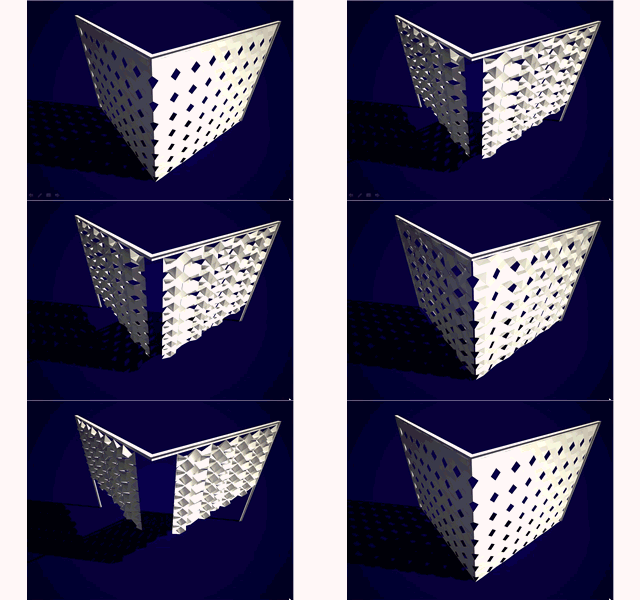
I was a bit lazy with the animation, only a few versions to show the range of motion. The panel as rendered is 7 feet high by 9 feet wide.
I was a bit lazy with the animation, only a few versions to show the range of motion. The panel as rendered is 7 feet high by 9 feet wide.
Tuesday, December 8, 2009
The next project with John and Cezanne
John, Cezanne, and I have been working / talking about the next project since this past summer. While we are still in the early stages, or at least my part of it is in early stages, I had a break through with the assembly modeling component in DP. The installation will be at a museum in Japan and we are trying to work with a repeated interactive module and origami. Below is a simple animation of the repeated parts as they fold. The top left corner is fixed, and as a result as the parts change, it impacts all the connected modules.
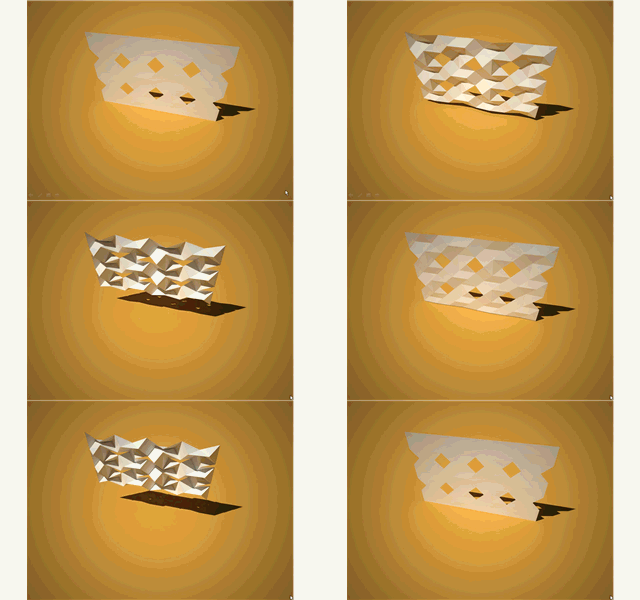
Below are a few of the parts simply arranged that also rolls the surface into a cylinder.


Wednesday, November 25, 2009
To some, this might seem redundant.
Labeling a stack of plywood, "PLY". The joke is that that is the name of the office. The driver did not appreciate that I asked him to step aside so I could take a picture.

Subscribe to:
Posts (Atom)