Sunday, March 22, 2009

Scripting - After Session 2

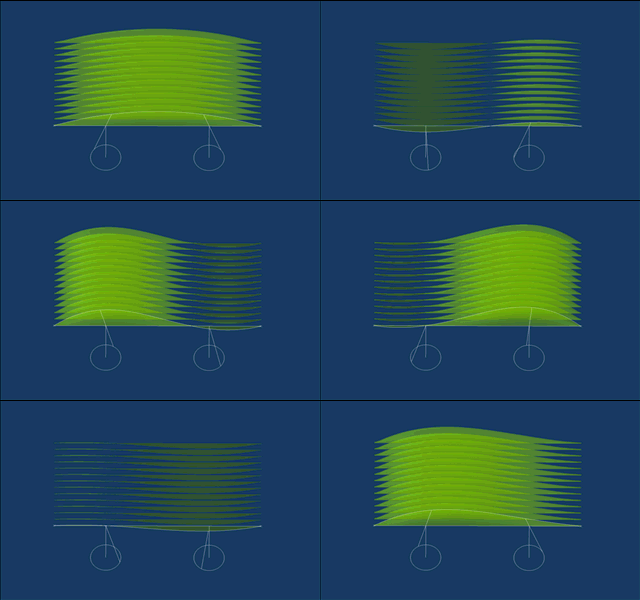
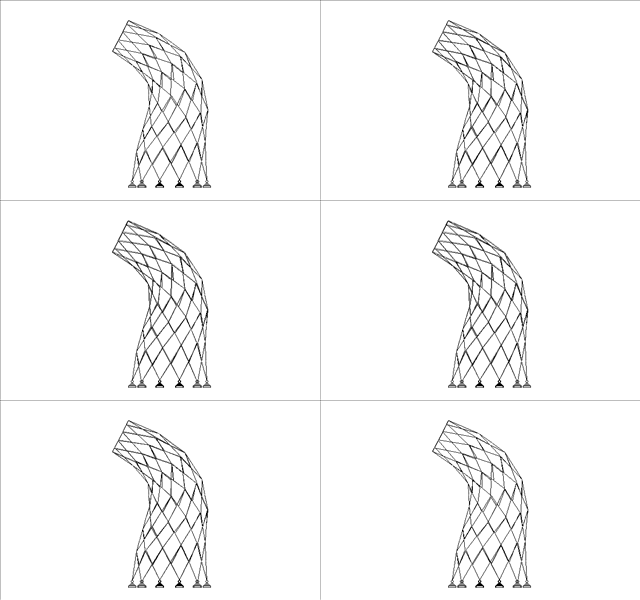
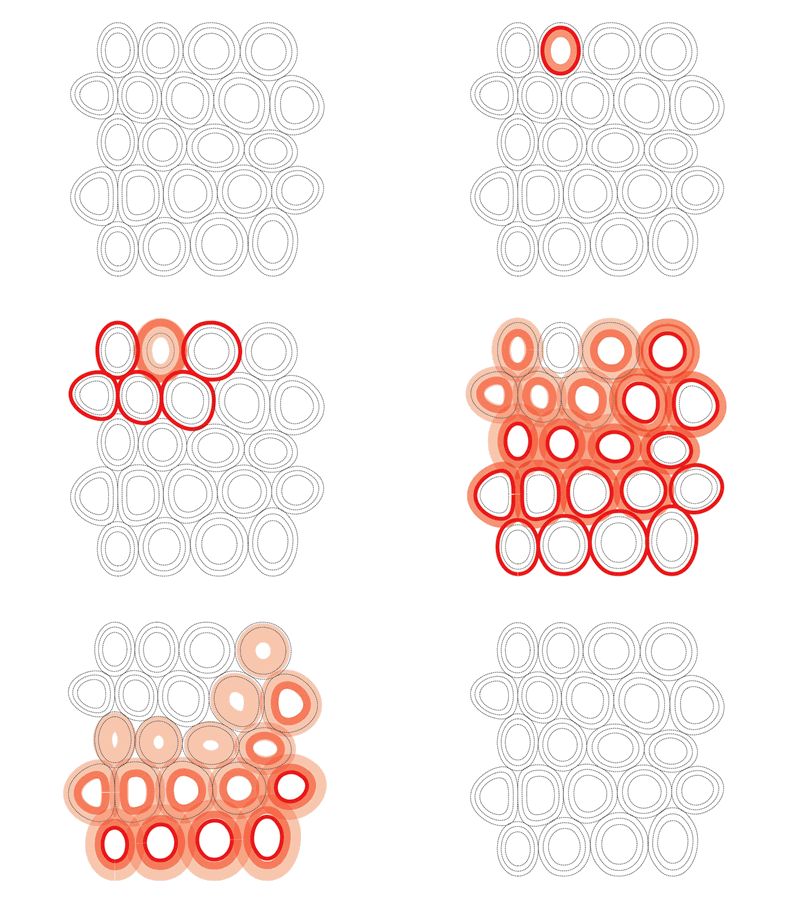
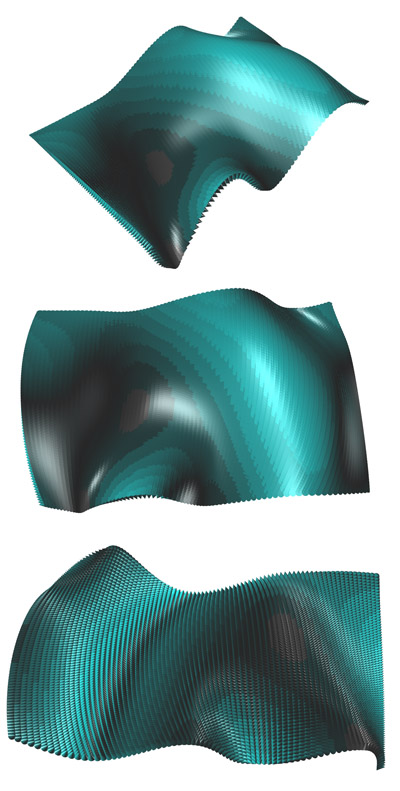
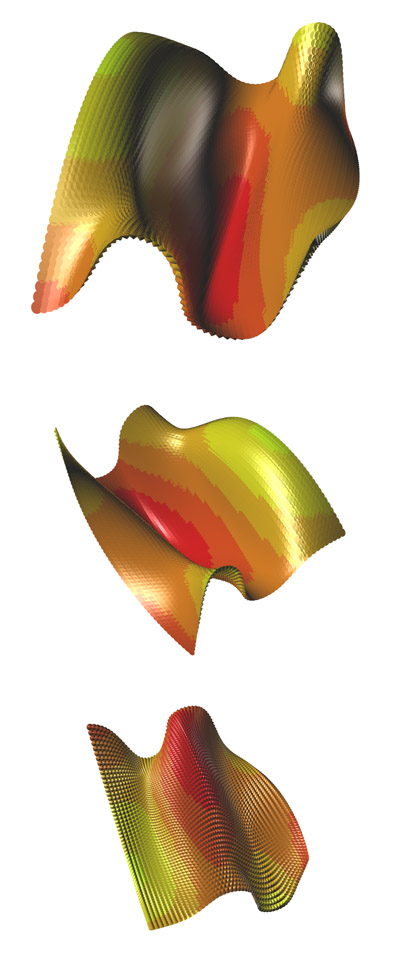
We had our second session with Marc Fornes this week and we started with a discussion of surfaces. The logic of surfaces relies on U and V instead of X,Y,Z. In the following studies I convert the UV back to XYZ so that I can map the height of the parts. The color is used to distinguish height. On my first iteration the color was gradual. In the included images, I rounded the values to the nearest 10 so that there are height contours shown with the color.


The studies were useful to get a better handle on arrays, capturing and using lists of values to map the cones to the surface and capture their Z values to control the color.

Here is a link to the script. Caution as it might be a bit sloppy as I was throwing all sorts of variables in to get it to work.


Thursday, March 19, 2009

Scripted Spiral Bowl

Building on the first scripting session I had a chance to play a bit more. Using the simple equation for a spiral, I created a curve to link the points, and then a series of lines to link other points. I guess it is a spiral bowl of some sort. The black dots are text dots so I can be sure which points to link with the lines. This can be turned off or on easily within the script. Here the loop helps to create the spiral. This was much harder to do with Grasshopper given the lack of looping.


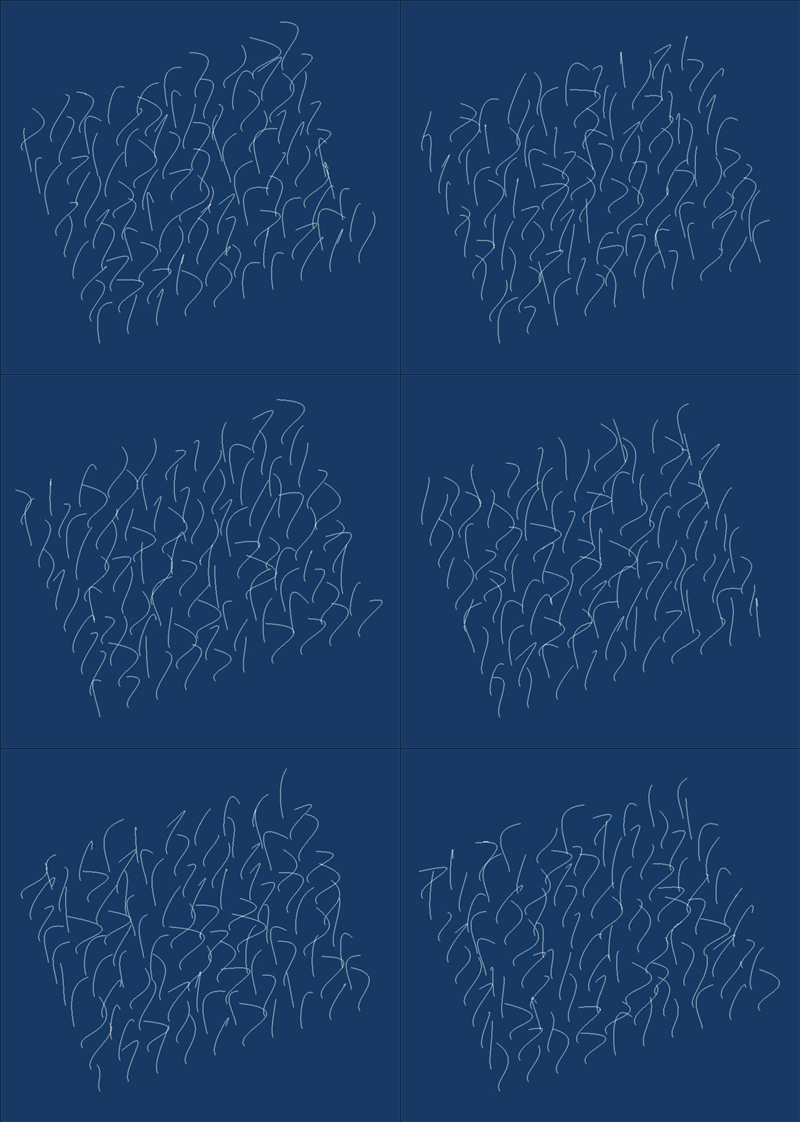
Here are a series of variations that manipulate the spiral equation to get different effects.

Here is a link to the rhino script file.


Sunday, March 15, 2009

Rhino Scripting - Session 1

This semester we have Marc Fornes doing a visiting grad options studio. In addition to that, we convinced him to do a few workshops for the faculty. So far we have had one 3 hour session and we were already making things. It was a great session, not stuck in the tediousness of variable types or anything like that, instead we made something, kept building, and could see the differences right away.


I had a couple hours to play today so I manipulated a few of our simple scripts from last week. Using a loop, arrays, and a couple of 'if then' statements, I am able to control the location, size, and color of many objects. In the examples I am using a bunch of spheres. The session this week will work on surfaces.

Here is a link to the RVB file.

Saturday, March 14, 2009

Research - Through - Making Grant

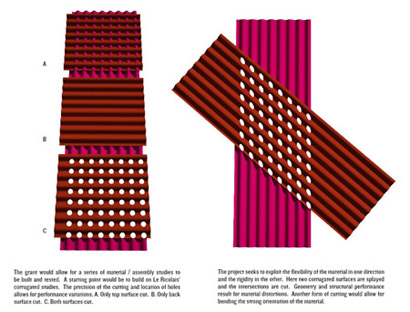
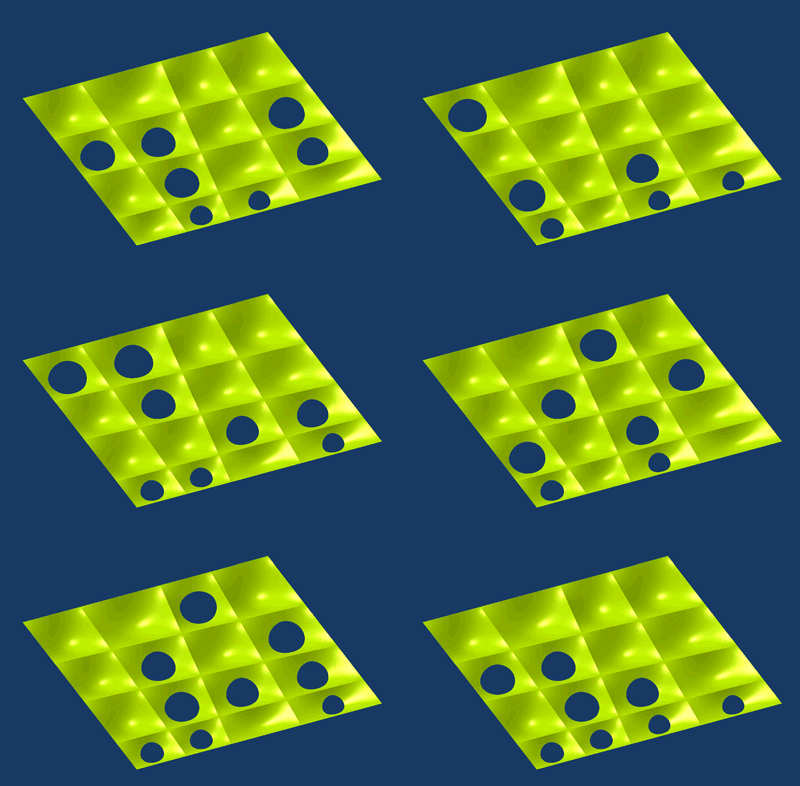
Through a new initiative at Taubman College and the University of Michigan, five faculty grants have been given to support the development of a project through making. My proposal entitled "In Search of the (w)Hole" was selected to be carried out this summer (to be completed by September).

It was Robert Le Ricolais, early pioneer of surface and space frame structures, that said "the art of structure is where to put the holes". His eloquent statement is even more relevant today given the ability to link the precision of the computer with the precision of computer controlled cutting equipment. While his statement was in reference to building-scaled openings, it is true of smaller scale cuts, perforations and slices and his statement highlights the potential of a detail to inform a process.


Digital Fabrication is most often celebrated for the construction of exuberant form achieved through extreme material usage. In this equation computer driven tools process neutral materials, resulting in bins full of saw dust or foam dust. This process perpetuates the idea that form comes first and construction is the act of replicating the form in the most exploitable material.


The Research-Through-Making Grant offers a chance to give material and process an upper-hand where forms might emerges directly through experimentation. This proposal takes a defiant stance against form over material. Two-dimensional cutting of sheet metal offers many opportunities because of the abundance of local shops equipped with cutting technologies and an array of readily available building materials.


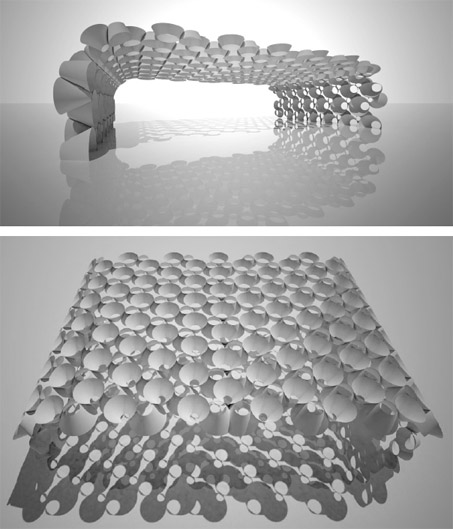
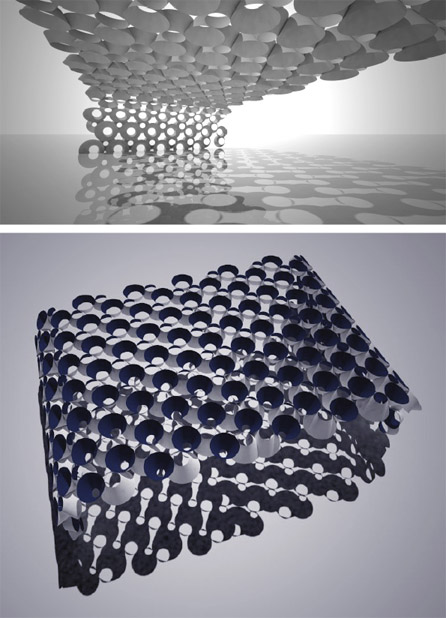
It is in these routinely used tools and materials that a designer can make the most significant impact, altering the landscape of production. 2D cutting is a subtractive process creating a strong conceptual and structural link where the removal of material both reduces weight and potential strength. The use of sheet metal allows for the creation of lattice or surface structures dependant on material properties and material organization. The assembly of the cut sheet metal extends the structural logic through the location of holes or tabs for potentially complex assembly by unskilled labor. This project will be used to build a structure capable of spanning at least 25’ which will require multiple assembled parts to achieve the required length and depth. Beyond the dimensional constraints of most materials available under 25’, the project aims to span beyond the scale of most lost-cost conventional framing systems (standard wood framing) while offering increased material and spatial affects.


The images included in the proposal are to help explain the general themes of the research more than to show that this is what will be built with the funding. The corrugated studies and conical studies are more of a starting point to initiate the research. As feedback is gained from initial material studies, the project and the form may move in different trajectories to fully investigate material outcomes or assembly techniques.

Thursday, March 12, 2009

Fire as Ice

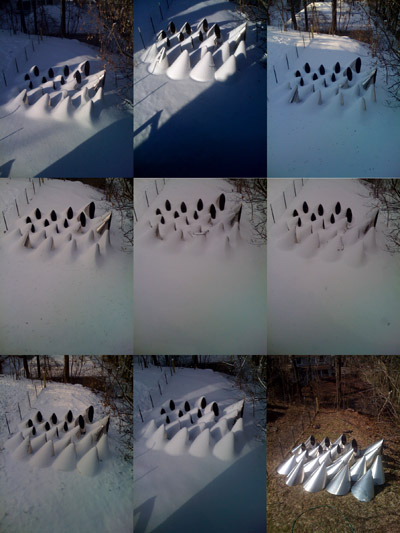
The experiment is almost over... Rather than simply recycle the Fire installation I put it in my backyard to watch it collect and drift snow during the winter. I hope the snow is finished for the season.


Twisted Surface

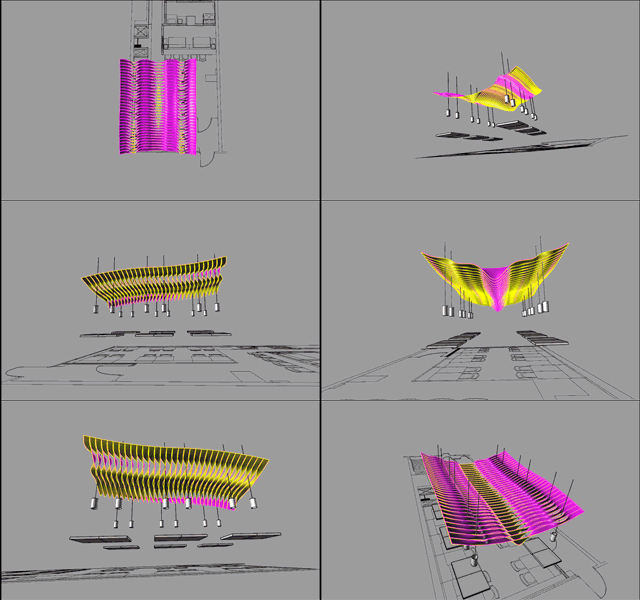
Currently working on a project for a small restaurant in Ann Arbor. Here are a few studies that continue the explorations into developable surfaces and smart surfaces. At this point it is not clear if we will have the time to explore a dynamic / responsive system or simply develop a restrained surface to create subtle distortions in the ceiling to allow for HVAC and lighting requirements.


Here is a parametric model that looks at using two servo motors to create s simple wave movement.


Simple walkthrough of a static surface illustrating the open and closed conditions of the surface made of sheet metal strips.


Saturday, February 28, 2009

Assemblies and Aggregations

A recent exhibit in the college gallery showcased student work from my ParaMod seminar and from Glenn Wilcox’s Digital Fabrication Seminar.


This post seemed like a good opportunity to post some of the work from last semester. Click on the project images to open the final PDF board which shows various configurations and mutations.


Sunday, January 25, 2009

Digital Project to STAAD

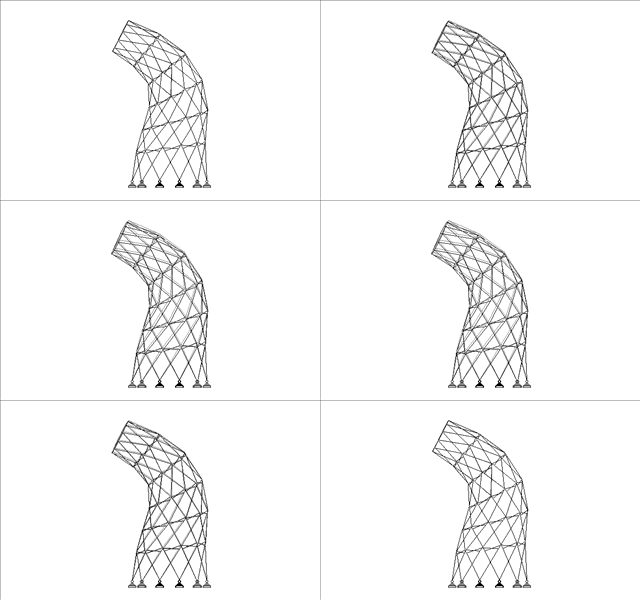
Here is a quick series of steps to go from Digital Project to STAAD. A few basics moves in STAAD will have quick feedback based on changes in geometry.


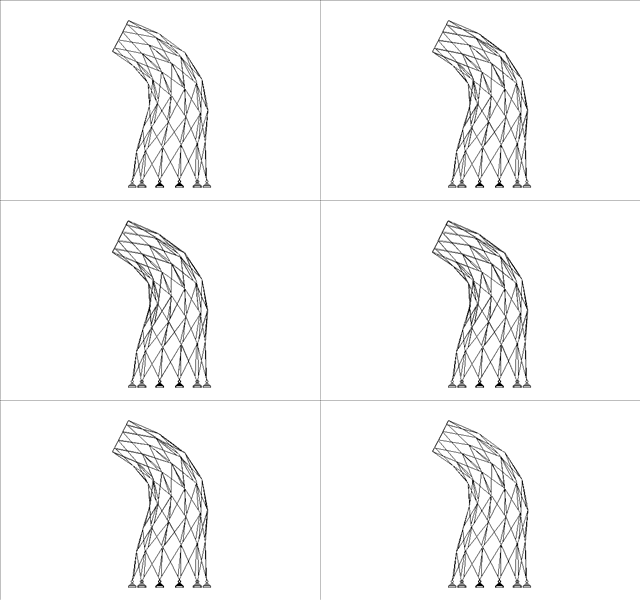
Simple animations below of three variations based on self weight loading. The cross member is in three positions 90%, 50% and 10% of its location to the vertical member. I was pleasantly surprised to realize that the 10% geometry deflects the least given the simple loading.


Grad Studio to engage Parametric, Biomorphic, and Structures

Cultivated Form

Through a whole series of unrelated events, my graduate studio this term will expand on parametric design, biological research and the design of wood structures. A new initiative is looking at linking technical courses with design studios. This is a first for Michigan and we are the test subjects. In our case students registered for the studio are also registered for the graduate wood structures seminar taught by Peter von Buelow. This limits both classes to the same group of students allowing us to modify to make connections between the two.

Given my ongoing interest in biological systems, genetics, and morphology the studio will look to the botanical. To this end we are making connections with evolutionary biologists and botanists from U of M. They have already been very helpful in discussing the "rules" that might be at play behind various genetic mutations and adaptations. In many cases producing a wide array of variation with simple rules.

As a means to push the discussion further and our need to get to a point of proposing wood structures, we are working with the New York Botanical Garden to develop a series of hypothetical / theoretical / prototypical projects in response to their future building and exhibition needs. Given the freedom and content of the studio, I imagine student will will find its way onto the blog.

Click here for a PDF of the studio description.


Wednesday, December 24, 2008

Knowledgeware Optimization

This tutorial introduces the knowledgeware warning function and multi-parameter optimization. In this tutorial I model a simple room and use its dimensions and configuration to analyze surface area and volume. Using the values, the reverberation time is calculated. As a first attempt at using the engineering optimization tools I let the software determine the room dimensions based on appropriate reverberation times.

Click the image to begin the streaming video.


Sunday, November 30, 2008

Random Numbers for Framework

This video tutorial attempts to pull together a few of the previous examples. A powercopy is used to adapt to its height and to be divided based on a random number from an Excel design table. The Excel spreadsheet can be a powerful tool to control geometry.

Click the image to get to the streaming video.


Saturday, November 15, 2008

Generating Drawings

Short tutorial that explains how to generate drawings using the drawing workbench in Digital Project. Click the image to start the streaming video.

Tuesday, November 11, 2008

Framework Options

Short video tutorial describes three methods for the creation of frameworks for use with doc templates and powercopies . Click the image to start the video.

Thursday, November 6, 2008

Fire Installed


John and I finished the installation of the Fire project and the the opening occured last night. Once I get a chance to photograph it I will upload more. For now, here are some i-phone shots.

There is more up on John's blog: http://designedobjects.blogspot.com/.

And some images from the opening from Earl Carlson: http://www.theearlcarlson.com/duderstadt/fire.html


'Fire' from John Marshall on Vimeo.

Sunday, October 26, 2008

Unfolded PowerCopy

Tutorial that explains how to include unfolded geometry in a powercopy.
The tutorial also shows how to use local and global parameters.
18 minutes. Click the image for the video.

Arts & the Environment: FIRE

As part of a University of Michigan initiative to explore arts driven inquiry, Arts on Earth sponsored multidisciplinary faculty teams to develop work that explores environmental issues. Since the summer I have been working with John Marshall from the School of Art & Design and Werner Dahm from the Laboratory for Turbulence & Combustion (Department of Aerospace Engineering). We were given the element of fire.

The opening night of the installations / performances is on: November 5 from 5 - 11.
Here is a link to
Arts & the Environment.

A series of aluminum forms will hold an array of autonomous interactive units that will respond to the movement and environmental conditions around it. The behavior is obviously informed by the dynamic qualities of fire.


Saturday, October 18, 2008

Random Numbers linked from Excel

This tutorial will describe the creation of a design table, allowing for the control of geometry from an Excel spread sheet. The design table is also useful for input and output of data from Digital Project. Using the random number generator from Excel, a rule is created to randomly open or close the geometry of a powercopy.

Here is a link to the video.


Saturday, October 4, 2008

Grasshopper - Brick Surface

This grasshopper example places a series of boxes on a lofted surface. Currently it is an approximation of a brick surface. The next file will follow the rules for corbeling to set a maximum curvature based on a brick module.

Here is the grasshopper file.


Thursday, October 2, 2008

Grasshopper - Array of Boxes

Simple Grasshopper video tutorial that shows how to make a series of boxes re-orient themselves based on a point.
Beyond the simple re-orientation the file uses both a MAX and MIN to control the size of the boxes.

Click the image to watch the video.

Here is a link to the grasshopper file.


Digital Project - Tutorial 5 - Document Templates

This is the fifth and last comprehensive tutorial for the ParaMod seminar. The five tutorials should give everyone a basic understanding of many of functions. I will continue to add shorter more specific tutorials.


Document templates allow for advanced replicatiopn at the product level, each part of the syetem is a separate file.


Click the image below to view the 40 minute streaming video.