Showing posts with label assembly model. Show all posts

Saturday, January 31, 2015

Re-configurable Formwork

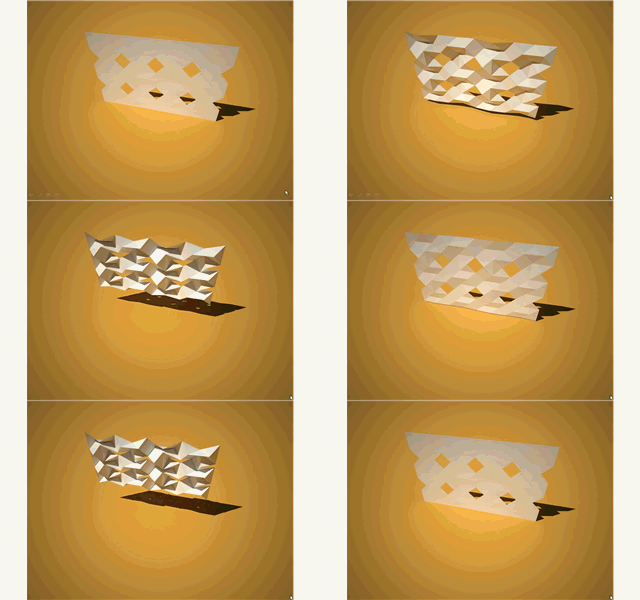
Building off the theme of a previous post, here is an example of a re-configurable formwork.  All the panels are the same and all the panels are identical.  By changing angles of the fold we are able to pleat or bunch, more and less locally across the surface.  Here we are also able to simulate the range of movement as it's not infinitely flexible.  As you pin the points, the overall assmebly begins to take its own form.

 
Image of physical prototype.


Tuesday, January 13, 2015

New Years Resolution 2015 - Less Mass Customization, More Smart Manipulation

No teaching this term so there is time to advance some work, thinking, and research.  

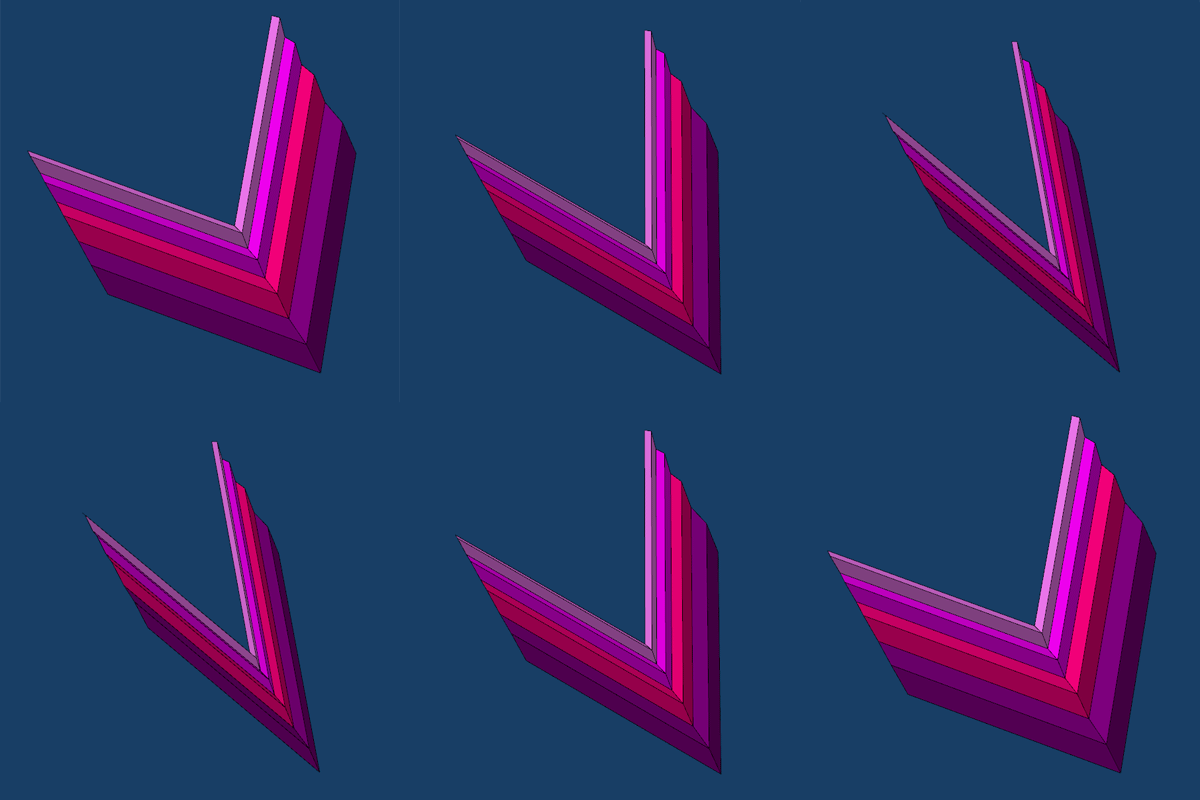
It is computationally inexpensive to create mass-customization but when it comes to some fabrication strategies the desire for complete unique parts begins to take its  toll.  Given the ability to control, develop, define, and manage geometric complexity I am developing some work which seeks to use standard parts that are able to produce custom configurations.  I have begun to understand a hierarchy of part to sub-assembly to assembly and the cost / value ratio is not spread equally throughout that system.  Using catia to simulate kinetic movement, parts can be fabricated (or 3D printed in compressed forms), shipped, and then reconfigured or opened.

Here is an animated screenshot of standard parts (with consistent lengths) manipulated by one parameter.  I am studying the joints, rotations, and range of movement.  This represents a framework for the control of more robust manufactured elements.


Sunday, March 27, 2011

Folding structure with variation

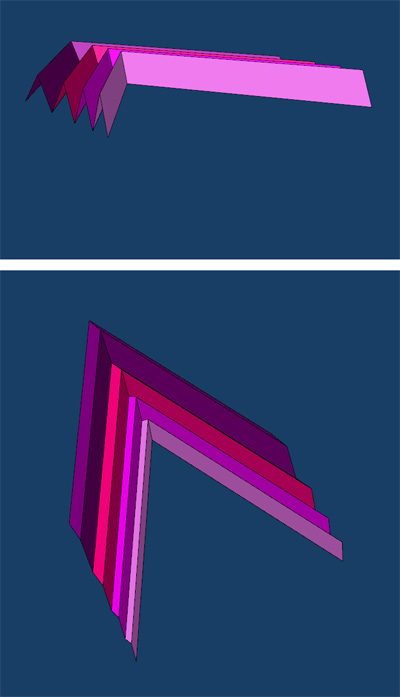
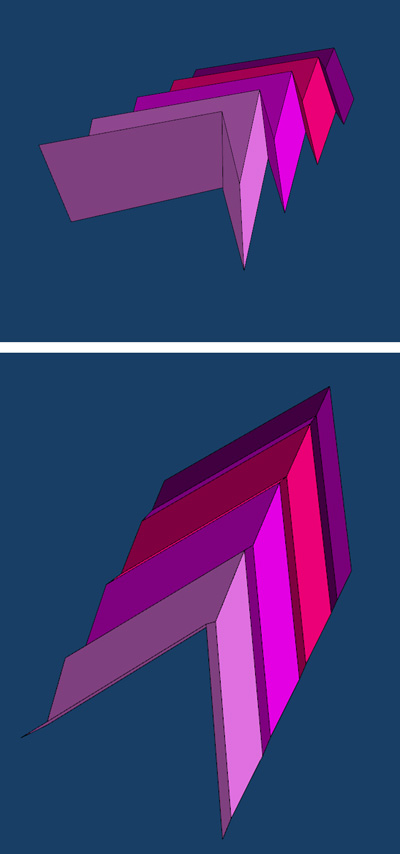
I had a bit of time to finally get around to the next stage of the folding structure.  I was curious if a variation in panel dimension or in panel angle would still work in terms of folding.  I was surprised to find out that both work.  Here are a few images:

Simple animation where the skeleton angle is varied, which results in the overall assembly folding or unfolding.

Variation of the panel angle only.
Here is the angle and length of panel varied across the assembly.

Thursday, February 3, 2011

Folding tutorial uses assembly model


Tutorial that shows how to use the assembly workbench to investigate folding geometry.  The folding pattern is based on research of the hornbeam leaf.  Paper on this type of research.


Click the image below to start the video tutorial. 


Important setting described here if you get an error referring to "published geometry".
 

Sunday, December 13, 2009

Next iteration of the folding panel

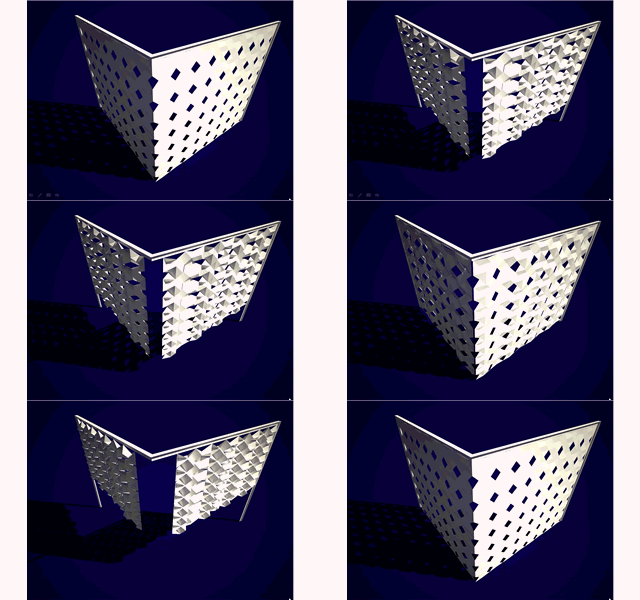
After trying a few options for the folding screen, here is one that uses the corner (or a fold in the surface) to open.  I was hoping for a more dramatic range from closed to open but the range is based on the range of the individual module.


I was a bit lazy with the animation, only a few versions to show the range of motion.  The panel as rendered is 7 feet high by 9 feet wide.


Tuesday, December 8, 2009

The next project with John and Cezanne

John, Cezanne, and I have been working / talking about the next project since this past summer.  While we are still in the early stages, or at least my part of it is in early stages, I had a break through with the assembly modeling component in DP.  The installation will be at a museum in Japan and we are trying to work with a repeated interactive module and origami.  Below is a simple animation of the repeated parts as they fold.  The top left corner is fixed, and as a result as the parts change, it impacts all the connected modules.


Below are a few of the parts simply arranged that also rolls the surface into a cylinder.