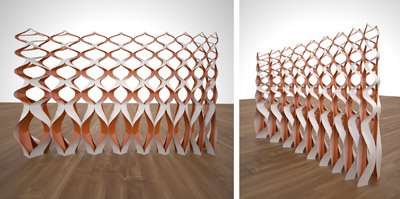
As a way to explore the potential of Rhino Grasshopper, I started working on a series of milled panels. Each panel varies through the use of a few simple variables (grasshopper uses slider bars). These values are fed to a random number generator so the behavior is somewhat unpredictable.
 The loft surface is built through a series of sin and cos curves, where the frequency is controlled by the variables (detail of the relationships below).
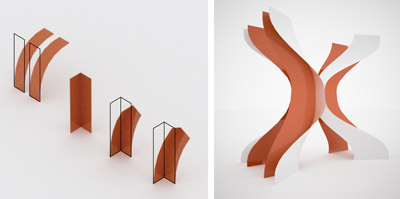
 Here are 4 sample surfaces made through slight modifications of the slider bars.
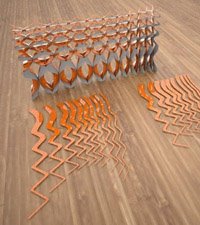
 The surface is then contoured to approximate a milled pattern.

As a variation of the simple surface, it gets slightly submerged into the stocck material, leaving a flat surface on the top with the remaining surface being milled. This reduces the material thickness and milling time.